
Cargo of Clericals: Early Transportation and Church Congregations
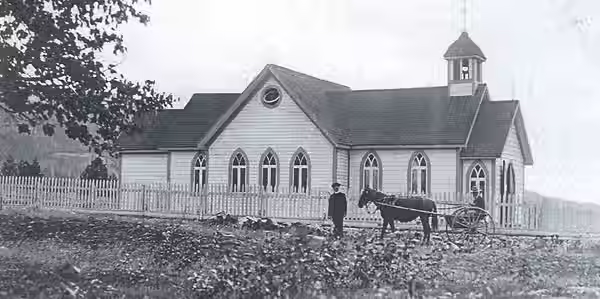
It was decided by Archdeacon Beer at the Synod of the Diocese of New Westminster, in 1909, that Okanagan Centre was in need of clergymen, as the lake boats ensured oncoming prosperity. At this time, if a community did already have an established church it was often inaccessible for a large portion of the congregation. Therefore, religious life in the Okanagan was no easy task and required both clergymen and churchgoers to heavily rely on and incorporate crude transportation systems into their worship.
It was the sheer distance needing to be scaled, from townsites and ship landings to distant churches, that saw transportation and religiosity so often paired together. Reverend Owen Bulkeley attested to this, stating, "To give some idea of the extent of this parish, it runs some twenty miles east of this great Okanagan Lake, and a like distance the western side, and there are three and a quarter miles of water between. Add to this that miles intervene between ranch and ranch, and that this Mission also supplies services over the mountains at two other great lakes, Woods and Long Lakes, and that settlements are springing up in out-of-the-way places, all included in this one great parish, and all looking to a single missionary to supply their spiritual needs [...] Here at Okanagan Centre the bulk of my parishioners can assemble, coming in on horseback, driving or by boat, so here we urgently require a Church." By the 1890s, Priests from Okanagan Mission and religious figures from other congregations could often be seen traveling on the ships and around the valley, evangelizing and performing religious duties. Parishioners too employed all modes of transportation to attend services.
In 1906, the ever-quiet Summerland was livened by the British Columbia Baptist Convention, which hosted the Baptist District Superintendent of Missions, Reverend A.J. Saunder, and a large group of churchgoers from across the country. Especially for the occasion, the S.S. Maude Moore and its scow were chartered to host a floating service and hymn-sing. However, the Maude Moore was no lavish vessel and had a reputation for its temperamental smoke stack, to which a constant rain of sparks was a feature.

The ship was first introduced to Skaha Lake in 1899 by W.J. Snodgrass of OK Falls, primarily for passenger use before the Columbia Western section of the railway was complete. Possibly named after the youngest of Snodgrass' daughters, the Maude Moore's hull was built in Peterborough, Ontario, while the machinery was salvaged from an earlier ship called the S.S. Jessie. She was then constructed, at least in-part, by Joseph Weeks, who would later become Captain of the S.S. Sicamous. In 1903, the S.S. Maude Moore was sold to J.M. Robinson, early inhabitant of Peachland and founder of Naramata and Summerland, to be used as a ferry between Penticton, Summerland and Naramata. By the time of the Baptist convention in 1906, to see the Maude Moore moving passengers was a rare sight.

Ted Logie was just eight years old when he on-looked the occasion, remarking in his memoir, Ted Tells (Okanagan) Tales, "A few of us were sitting on the end of the T.J. Smith wharf dividing our attention between watching a forest fire on the mountain well above Naramata, and progress of the Maude Moore and Scow with her cargo of clericals, lay delegates, wives and daughters. Spasmodically we could hear singing from this floating meeting place, which gradually faded as the boat steamed further south and the wind, which had freshened, carried any semblance of gospel music away into the distance." These winds of course turned into an unkindly breeze for the passengers who now understood why the Maude Moore was so often seen tied up rather than sailing. "The prayer meeting, which had so peacefully embarked on its evening voyage, its sole idea being one of thanksgiving, now turned into an exhortation for immediate deliverance and paeans of praise, which one ascended heaven ward , were now transcended by songs of supplication rendered with deep feeling and singleness of purpose and by the noises made by worshippers extinguishing the good-sized sparks which of necessity, continued to spew from the Maude Moore's smokestack." The small passenger steamer struggled to shore, where the guests then scrambled off the ship back to the more trusted land.
However this was not the first mishap for clericals aboard the valleys' early ships.

Archdeacon of the Okanagan, Thomas (Pa) Greene, had his route set for traveling across the lake to marry Hamilton Lang and Gertie Pope. First Greene was to board the S.S. Aberdeen in Kelowna and travel to Peachland, before later making his return trip on the "Westward Ho" that evening. His trip on the Aberdeen was all smooth sailing. The Archdeacon would have pay for a ticket at half price, as all clergymen aboard the Aberdeen would, before then watching the CPR sternwheeler calmy maneuver itself down the lake. Greene arrived in Peachland not soon after and married the couple on June 17th, 1903. However, as the ceremony progressed so did a storm. The Archdeacon boarded the small ferry and, despite the poor weather, began down the lake. Captain Len Hayman and Pa Greene had only just began the crossing to Squally Point, at Rattlesnake Island, when a large wave put out the poor "Westward Ho's" engine. Captain Hayman recounted the story, saying, "I tried to bail and start the engine at the same time. Pa Greene was in the bow holding the sail and praying. Finally I got the motor going. When we got out of the storm I said, "You were doing some pretty good praying up there during the storm." He answered "yes, but not for myself."' Twenty-five years later the captain and Archdeacon reflected on their near demise at Squally Point, with Greene concluding that it was his praying that saved the day and Hayman thanking his handy work as a spontaneous boiler mechanic.
Another time, Dr. Hogg D.D. was visiting his son in Summerland, bringing along a son-in-law and friend, all of whom held positions in the Presbyterian church. Dr. Hogg's son, Ken, was something of a legend in town. Ken Hogg was the first teacher of Summerland, the shop keeper of the Hogg's drugstore, shareholder in the Summerland Telephone company and a member of the Summerland band, president of the Board of Trade, Masonic Lodge and the Independent Order of Odd Fellows. Alongside his many occupations, Ken Hogg was a hobby sailor, owning a small regatta boat called the "Spider." In comparison, the patriarch Hogg and reverend sons' sailing experience consisted of relaxed journeys on paddlewheelers and time spent observing Ken Hogg on the Spider.

Ted Logie recounts that the men, "had watched Ken as he expertly handled sheet and rudder, knew from attentive observation that it was the centre board that was lowered, not the floorboards, his nonchalant way of doing things had impressed them, and all they had to do was follow his example." Soon the three religious had boarded the Spider, finding no trouble in hoisting her sail. However, their lack of sailing experience was realized in a matter of minutes, as with much commotion, the men were now struggling to regain their capsized boat. Their shouts were heard from the clay banks around Summerland and soon the three soaking ministers were being dragged back to shore.
Seemingly Okanagan Lake and her crude ships had no sympathy for the many religious who so often seemed to find trouble when afloat. Ted Logie commented on the Maude Moore and Spider's little incidents, "Those of the Baptist persuasion, when in need of assistance, prayed, when those ministers of the Presbyterian faith were in dire circumstance and required help, they yelled. There must be some doctrinal implication here that theological savants might be able to define. [...] Strangely enough both systems worked, so I suggest the use of some of each." Beyond this quip, perhaps these stories better serve as a testament to the resilience of our pioneers who not only made do, but were able to laugh about the unpredictability of these early transportation systems to which they so heavily relied.
Comments