
Early Commercial Ships of the Okanagan Valley
Updated: Jul 7
The first talks of a commercial steamboat operation on the Okanagan and Shuswap Lakes came on July 16th, 1861, when Governor Sir James Douglas proposed the idea to the Home Government. Douglas imagined operating a steamboat service on the two lakes, with a wagon road connecting the ship routes, as a way to open the province to settlers. Soon a wagon road had been completed between Ashcroft and Savona's Ferry, BC, and the first steamboat was placed on Shuswap Lake in 1866. This transportation route was further expanded in 1873 with a wagon road between the head of Okanagan Lake in Vernon and Spallumcheen, BC. However, despite this development of infrastructure in the region, the Okanagan continued without a steamboat until the private enterprise of Captain Thomas Shorts and Thomas Greenhow in 1886, 20 years behind the Shuswap.
Once Thomas Shorts introduced the first steamboat on the lake, there was a steady rotation of new and better commercial vessels in the Okanagan, continuing until the mid 20th century. Each of these ships, however small, seemed to achieve a personality of it's own, solidifying themselves into the collective memory of the community. In the Okanagan valley, each of these distinctive personalities helped to establish and provide for the settler communities in a myriad of ways.
However unique these vessels might have been, it certainly can be said that each ship in some way impacted one another. A testament to this interconnectivity can be followed through the example of the S.S. Mary Victoria Greenhow. The first steamboat on the lake, the S.S. Mary Victoria Greenhow, was a modest privately owned vessel who provided passenger and freight services. After burning to the water's edge in 1887, her engine was salvaged and kept for her captain's second ship, the S.S. Jubilee. When the 'Jubilee' was subsequently ruined by a rough winter at Okanagan Landing in 1889-90, Captain Shorts put her machinery into a barge which then became known as the S.S. City of Vernon. Not soon after, when funds were scarce to build the S.S. Penticton passenger ship, Shorts sold parts of his property and the 'City of Vernon.' Under new ownership and several years later, the 'City of Vernon' had her engine removed and placed into a new ship being built with lumber from the superstructure of the S.S. Penticton. Here we get the S.S. Wanderer, built around the original engine of the Mary Victoria Greenhow, which had already been repurposed two times prior, and wood from the S.S. Penticton. The engine was eventually used at Trinity Valley for a shingle and wood-cutting mill, starting in 1906, and was given to the Vernon museum in 1957 by the Worth family.

S.S. Mary Victoria Greenhow, 1886

Net Tonnage: 5
Length: 32 feet
Beam: 5 feet
Engine: 2 horse-power coal-oil-burning
Captain Thomas Dorling Shorts began commercial passenger services on Okanagan Lake in 1883 with his 22 foot rowboat called the "Ruth Shorts." Built by carpenters John Hamill and John Pringle of Lansdowne, Shorts manually plowed the lake, providing passenger services to the Okanagan. After three years of this service, Shorts decided it was time to commission an engine driven passenger vessel. This important undertaking was not subsidized or aided by the government, despite the keen interest of Governor Douglas, and involved the initiative and funding capable of T.D. Shorts and, O'Keefe cattle rancher, Thomas Greenhow, alone.
Despite their not being shipwrights, Captain T.D. Shorts again commissioned Hamill and Pringle's carpentry shop to make his vessel. Her two horse-power coal-oil-burning engine was manufactured in Rochester, New York, and was brought up to the head of the lake in Vernon. She was also fit with a small kerosene burning boiler. The small, five passenger, open air ship was named after the only daughter of Thomas and Elizabeth Greenhow. Her maiden voyage was attended by builders Hamill and Pringle, E. M. Furstineau, William Lawrence, B.F. Young and Robert Wood, who sailed to Falls Creek with Shorts as captain. This short trip was successful and provided false hope for her service.
Not long after her launching, Shorts and the Mary Victoria Greenhow started on her first trip to Penticton, carrying five tons of freight, five passengers and towing another boat behind her. What Shorts neglected to consider was the oil consumption of such a heavy load and had exhausted his one barrel supply of coal-oil long before having reached the city. "The result was that when the "Mary Victoria Greenhow" got back to the head of the lake, the settlers had all gone back to candles. There wasn't a tin of coal oil left on the lake. Shorts hastened to impart the inflicting intelligence to his partner. "Tom Greenhow" he shouted as soon as he saw him "Tom Greenhow, we are a busted institution, that's the matter, we are ruined, one more trip like that and we are a financial wreck" remembered L. Norris, "When she reached Penticton something of a demonstration was staged and a salute of 21 guns fired in honor of the event." The story continues to be told today, with some joking that the return trip saw previously illuminated communities now in complete darkness as Shorts had used up all the oil in the Okanagan. Despite her oil consumption, the ship was a welcomed addition to these waters and provided much needed passenger services until 1887.
One day, Shorts left the Mary Victoria Greenhow tied up at the wharf of Okanagan Mission, while going to borrow more kerosene from the Lequime general store. The captain returned to find the ship badly damaged by fire. He only just managed to get her to Okanagan Landing, where the Mary Victoria Greenhow was repaired and her boiler converted to that of a wood-burning model. From then, it was not an uncommon feature of a voyage with Shorts to make the forcible excursion to stop ashore and chop one's own wood for the boiler. Shorts, understandably, found this business unsustainable and moved towards the building of his next ship.
S.S. Jubilee, 1887
Length: 30 feet
Beam: 8 feet
Shortly after the fire onboard the S.S. Mary Victoria Greenhow, it was decided by Shorts that the commissioning of a new vessel was needed to serve the valley. With his business partner, John Hamilton, Shorts built a small clinker built steamer using the engine of the S.S. Mary Victoria Greenhow.
Named in honour of Queen Victoria's fifteenth year on the throne, the S.S. Jubilee was launched on September 22, 1887. The Kamloops "Inland Sentinel" newspaper covered the launch stating, "On Thursday last of that part of the shores of Okanagan Lake due south of our village, presented a lively scene. the event was the launching of the 'Jubilee,' with new boiler and engine, fully equipped. At about 12 o'clock a party of about twenty left Priest's Valley to witness the launch. [...] Exactly at 3:30 the launch of the 'Jubilee' was successfully made amid cheers from the crowd. A short spurt down the lake proved the excellent sea-going qualities of the boat."
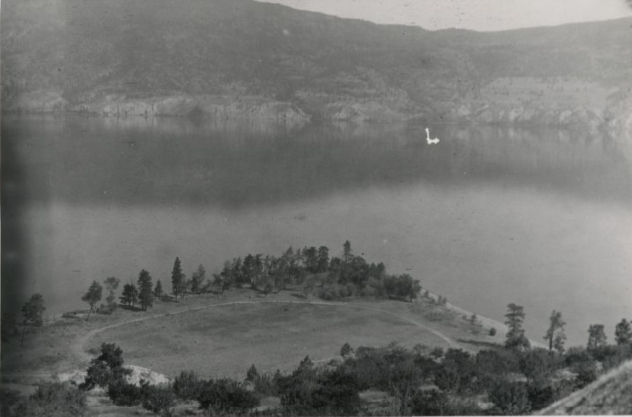
Business prospered for the S.S. Jubilee and Shorts between 1888 and 89, as large amounts of supplies were being freighted to the Similkameen, as a result of a gold strike in Granite Creek. Shorts had so much business moving freight in fact that he had to build a store house to accommodate the sheer amount of cargo. This building could have been found at the ship port connecting the lake to the Granite Creek trail and was known as "Storehouse Point," now called Crescent Beach in Summerland.
In the winter of 1889-90, the S.S. Jubilee was heavily damaged by ice after being tied up at Okanagan Landing for the winter. The engine and boiler were removed from the S.S. Jubilee, to later be placed in the S.S. City of Vernon, and she was decommissioned.
S.S. Red Star (Okanagan, Lucy), 1887

‘S.S. Red Star’ no. 90787
Gross tonnage: 14.81
Net Tonnage: 10.08
Length: 33 feet
Beam: 9 feet
Depth: 3 feet
The story of the S.S. Red Star begins not in the Okanagan but rather with her service on the Spallumcheen River, now known as Shuswap River. This small screw steamer was built and registered by a J. Nickols of Victoria, and brought up to the interior by the Enderby Flour Mill Company. Her role was to run flour, mail, and passengers up the river from Enderby to the mainline of the Canadian Pacific Railway at Sicamous. However, due to the shallow draft of the vessel she struggled to operate over the river's sand bars and partially sank in 1888. The destroyed Red Star was raised shortly thereafter, with the S.S. Red Star II promptly being built around her machinery.
The Red Star II was commissioned by R.P. Rithet, who then owned the Columbia Flour Mill, and was captained by Duncan Gordon Cumming. Rithet had the screw steamer converted into a flat-bottomed scow-shaped sternwheeler that had a capacity of 12 passengers. She had scheduled runs to Sicamous on Mondays, Wednesdays, and Fridays, and to Enderby on Tuesdays, Thursdays, and Saturdays. And while the S.S. Red Star II had more luck operating than the Red Star I, the vessel was only just able to trudge through the rivers' sandbars. The Red Star II, known colloquially as the 'Slow Molasses', struggled to keep any semblance of her schedule. Finally, she was abandoned when the rail connection between Okanagan Landing and Sicamous was made.
At this time, three men by the names of Alex Porteus, Allan Gillis and Roland R. MacDonald, had the abandoned hull of the Red Star I brought up from the Spallumcheen River. She had 20 unregistered feet added to her hull and new machinery, furnished by Nicholes and Renouf of Victoria, installed. From then, the S.S. Red Star ran on Okanagan Lake and was fittingly renamed "Okanagan."
In 1890, under the ownership of Alexander Dow and Allen Gilles, workers on the O'Keefe ranch, she then began a short career doing unscheduled freight and passenger services on Okanagan Lake. Thomas Shorts ran something of a monopoly on commercial lake services in the Okanagan valley and found his first competitor in the S.S. Red Star.
The next year she was sold to the Lequime brothers, well known for their work in shaping the city of Kelowna, who used her as a camp tender and tugboat for moving logs and other freight.

In May of 1894, the boat was bought by engineer of the Aberdeen, W.B. Couson, and Angus Campbell for 100 dollars. Angus Campbell recalled, "We took the hull and machinery to Okanagan Landing and repaired the hull, and Couson, who was something of a genius with steamboat machinery, soon had her in running order with the pressure in the boiler reduced by the inspector to 85 pounds." Two months later, Couson sold his share of the ship to a man named Hultman. Hultman and Campbell ran her on Okanagan Lake until 1895. Before then loading her onto two flat cars and shipping her to Revelstoke, then by water to Robson, and later by rail to Nelson. In Nelson, she had a new boiler put into her, that had a capacity of 125 pounds pressure, and was used for towing cargo under the names S.S. Lucy and again S.S. Red Star. The S.S. Red Star was retired in 1915.
S.S. City of Vernon (Mudhen), 1890

"City of Vernon' registered 122400
Length: 50 feet
Beam: 11.2
After the S.S. Jubilee froze at Okanagan Landing in 1889, it was there that she sat untouched until spring, when shorts removed her engine and boiler and placed them in the vessel he had named the S.S. City of Vernon. The 'City of Vernon' was a crude vessel built to keep passenger services running while Captain Shorts and Thomas Ellis worked on the details of larger passenger ship.
Once plans were made for this next project, Shorts promptly sold the 'City of Vernon' to Alexander McCauley and Alexander Grant, using the money made to then build the S.S. Penticton. At this time, McCauley and Grant owned a ranch at Okanagan Landing, presumably employing the 'City of Vernon' for ranch tasks like hauling freight.
In 1896, the S.S. City of Vernon was purchased by Ashton, Valentine, and Caesar who planned to operate their ranch using the money made from odd jobs with the ship. By this time, the 'City of Vernon' was in complete disarray as she badly leaked and struggled to run. Their plans of service soon crumbled as, on march 4th, 1896, the three spent a day simply trying to keep the ship, now known colloquially as the Mud-Hen, from sinking. Caesar described the ship as something similar to an open deck skow with an engine, unideal for any real business, "The lake was rough and the temperature was two degrees below zero. As the waves washed into the boat, ice formed on the sides, so we had to bale out the water and knock off the ice. We kept this up until midnight, and we finally won the struggle. After our experience we decided to build another boat, using the engine of the Mud-Hen." After this treacherous voyage the group decided to build a new ship around the S.S. City of Vernon's machinery. While not much can be said after this point, she was presumably scrapped shortly after.
Shorts' S.S. City of Vernon (Mud-Hen) on Okanagan Lake is not to be confused with the ship of the same name seen on Kalamalka Lake from 1908 onwards. This ship was owned by Billy Johnston and Bob Carswell of the S.S. Wanderer and Alert, and was used captained by Larry Carswell.

S.S. Penticton, 1890

‘Penticton’ Registered New Westminster no. 96948
Gross Tonnage: 49.69
Net Tonnage: 33.79
Length: 70 feet
Beam: 16 feet
In the spring of 1890, Thomas Shorts commissioned for a new ship to be built, using the money received from the sale of "Shorts Point," now Fintry Provincial Park, and the S.S. City of Vernon. With its woodwork made by McAlpine and Allen of Vancouver, and machinery from the Doty Engine Company of Toronto, the first steamer with passenger accommodations was ready to serve on Okanagan Lake.

Her keel was laid at Okanagan Landing in April of 1890, by June she was fit for her machinery, and, with some delays, in September she was ready to be launched. As Captain Joseph Weeks recounted, "When the work on the hull was well advanced in the spring of 1890, it was found that the boiler and engine would not arrive until sometime in July. The contractors accordingly returned to Vancouver, and when the boiler and engine arrived, these were hauled in to Okanagan Landing with teams, probably from Kamloops. To show how resourceful men were, by force of circumstances, in those days, it may be stated that Captain Shorts and Henry Colbeck, who had been engineer on the "City of Vernon," unaided succeeded in raising the engine and boiler up the side of the vessel and lowering them into position with no other appliances than an antiquated hand wrench and a couple of jack screws."
She was a fine vessel for the time, the largest the lake had ever seen, and was registered as a twin-screw passenger boat with room for 25 passengers and board for 1. However, despite the fact that Shorts now had a motor driven boat to run his passenger services, he continued to struggle with keeping a schedule, so those traveling on the S.S. Penticton were often met with inconvenience.


From her creation until 1892, Thomas Ellis and Captain Thomas Shorts had equal ownership of the vessel. She was then sold to Leon Lequime of Kelowna for $5000. Leon Lequime continued her passenger service for the summer of 1892. She was tied up for the winter of 1892-93 and much of the spring, before then being put back to use that next summer. At this time she was operating under Captain Thomas Riley, and her crew of Alexander Dow, Allen Gilles, Jules McWha, Harry Colbeck and William Donaldson.
The Lequime brothers later altered her service from a passenger freighter to a tow boat for the Kelowna Saw Mill Company, privately hauling lumber and supplies to the mill.
The S.S. Penticton was dismantled in 1902, with her her machinery repurposed and her hull beached near the city of Kelowna, where it later burnt in 1905. Her boiler was transferred to the Kelowna Saw Mill's S.S. Kelowna, before then going to the Okanagan Mine. Frank Stevens acquired the name plate off of the S.S. Penticton and had it displayed on the front of his cabin at Caesar's ship landing for many years.
S.S. Aberdeen, 1893

‘Aberdeen’ Registered Vancouver no. 100675
Gross Tonnage: 554.04
Net Tonnage: 349.05
Length: 146 feet
Beam: 29 feet
Depth: 8 feet 8 inches
By the closing years of the 19th century, the railway had yet to be built south of Vernon and transportation was limited to the crude vessels aforementioned or horse and wagons. Therefore, with the first CPR ship and paddlewheeler on Okanagan Lake, the S.S. Aberdeen, an era of modernity and progress was ushered into the valley.
Under master shipbuilder Edwin G. McKay of Portland, Oregon, the building of the vessel began at Okanagan Landing shipyards in 1891. Her engines were built by the B.C. Iron Works of Vancouver, whiler her boiler came directly from the CPR. Designed by John F. Steffen, she had a flat-bottom wooden hull and a traditional design and brought a level of opulence and stability, previously unknown on these waters. She proceeded the S.S. Penticton's single room structure with 11 furnished staterooms, a dining room, men's smoking saloon, ladies' saloon, and a spacious cargo deck.

She was launched May 22nd, 1893, and began her tri-weekly passenger and cargo services that June, running between Penticton and Okanagan Landing. She was originally captained under J. Foster with R. Williams as mate and W. Couson as chief engineer. The S.S. Aberdeen briefly paused services from mid-January of 1894 until March, with the S.S. Penticton picking up a twice-weekly schedule. In later years, the 'Aberdeen' ran services through the winter, with aid of her relief vessel, the S.S. York and an ice-breaking barge.
The Aberdeen ran a incredibly successful service, which necessitated larger paddlewheelers to accommodate the demand. She was retired and decommissioned in 1919.
S.S. Jessie, 1894
'Jessie' registered New Westminster no. 103291
Gross Tonnage: 5.65
Length: 30 feet
Beam: 7 feet
The S.S. Jessie was a small steam launch that navigated Okanagan river and Skaha Lake. She was built in Ontario for W.J. Snodgrass, the first promoter and townsite developer of Okanagan Falls, and was shipped up to Okanagan Landing for construction.
It is quite possible that the S.S. Jessie was used to move freight from Penticton to the mining camps of Fairview and McKinney, considering the journey she was known to make from the Penticton CPR wharf down to Snodgrass' wharf and transportation centre in Okanagan Falls.
The S.S. Jessie burnt in 1898. Her boiler and engine were salvaged and later placed in the S.S. Maude Moore.
S.S. Fairview, 1894
Registered Victoria no. 103473
Gross Tonnage: 42.58
Net Tonnage: 26.83
Length: 55 feet
Beam: 15 feet
Depth: 2 feet 9 inches
The once booming mining camp of Fairview, just a few kilometres from present day Oliver, was first staked in 1887. From then, several mines were opened and the population steadily increased. In 1897 the first townsite was laid, hosting some 5000 people and operating a total of five mines. The men of the Fairview mining camp had only the agonizing dirt trail, with a 41 kilometres hauling distance, to connect them with supplies brought in to Penticton. Interest in a small sternwheeler to move passengers and cargo from Penticton to Okanagan Falls eagerly grew, as it promised cutting labor and travel times in half. The idea was expanded even further by W.J. Snodgrass who imagined a ship that could travel from Okanagan Landing, through the Okanagan River, and down Skaha Lake, ending at the mining transportation centre in OK Falls. A small group was formed called the 'Snodgrass Syndicate," willing to risk the capital needed to build and operate such a vessel. Among this group was Engineer William Couson of the S.S. Red Star and Aberdeen, and Captain Thomas Riley of the S.S. Penticton.
After much planning on the part of the syndicate, the humble S.S. Fairview sternwheeler was launched in the spring of 1894 with a moonlight cruise led by Captain Riley. On August 11th, 1894, the Fairview made its way down the Okanagan River bound for Okanagan Falls. Surprisingly, it was not the notorious sandbars that led this trip toward near disaster but low hanging branches. The ship's wheelhouse had received significant damage, having been caught up in the trees, and had to halt her service. She made her way back to Okanagan Landing for repairs in defeat, as her wheel and captain stood exposed to the elements. Her hull was also subsequently lengthened to 55 feet, meant to accommodate rough weather.
The S.S. Fairview had a successful run on Okanagan Lake in 1895, despite her meagre comparison in accommodation and service to that of the Canadian Pacific's S.S. Aberdeen. The CPR was however less than impressed with the S.S. Fairview and her service, fencing off access from the rail connections at Okanagan Landing to the wharf used by the lesser ship. Business struggled but persisted that summer, before she was then tied up until June, 1896.
A month into her summer service of 1896, tragedy struck. The S.S. Fairview was gaily decorated for an excursion to Kelowna with the Vernon Lacrosse club, when, after being docked for the night of July 1st, the ship caught aflame. With no one there to save her, the wooden vessel burned to its entirety, her machinery and hull unsalvageable. Captain Thomas Riley, now without a ship to man, dropped in rank to become a mate on the S.S. Aberdeen, and the S.S. Fairview faded from memory.
S.S. Wanderer (Violet), 1896

Gross Tonnage: 10
Length: 40 Feet
Beam: 9 Feet 6 inches
Engine: 5 horse-power
In 1896, the 'City of Vernon' was bought by Ashton, Valentine, and Caesar, who would soon discover her hull's troublesome tendency to sink and decided that it would be wise to build a new ship using her engine. The trio then acquired the housework of the S.S. Penticton from the Lequime brothers, who had surplus lumber from converting the ship into a tow boat. Additional lumber used for the ship, logs of fir and wine maple to be exact, was sawn at the Kelowna Saw Mill free of charge. The early days of construction were remembered by Northcote Caesar himself, stating, "We had the stem post and keel all in one piece of solid fir. Then we got vine maple and small fir for the ribs. After making a model of the boat we wanted to scale 1 inch to the foot. We built a large shed on the shore to build it in, this had a roof and floor only, with a bench on each side to dress the lumber on. After cutting the moulds I started on the boat, this was my job. Tools were very scarce especially the right ones, however, it got built and at the launching Christened by Mrs Woods." This ship was named the S.S. Wanderer and, after being christened with a bottle of champagne, ran services on Okanagan Lake.
Caesar remembers, "With the S.S. Wanderer we did odd jobs whenever we got a chance. We hauled ore from the Morning Glory mine, located opposite Okanagan Landing across from Whiteman's creek. The scow carried about 30 tons and we got $25 for towing it. We also took dynamite to Penticton since the S.S. Aberdeen was not allowed to carry it with passengers. We also towed logs to the Kelowna Saw-Mill, about 100,000 feet to the raft. This had to be done at night when the lake was calm. Our speed was 1^2 or 2 miles an hour."
In 1899, Caesar and Valentine divided up their shared property and assets, with Valentine taking the S.S. Wanderer. Valentine soon sold the ship to Billy Johnston and Bob Carswell of the Johnston and Carswell Sawmill company, who then used the 'Wanderer' for towing logs and other odd jobs on Kalamalka Lake. In 1901, the ship acted as a ferry in Kelowna, under Walter L. D'Aeth and then she was later owned by a William "Hoodlum" Smith, who renamed her S.S. Violet.
While not much is known about the ship after this point, it can be presumed that she was decommissioned sometime in the early 1900s, as her engine began being used in the Worth Shingle Mill in Trinity Valley as early as 1905.
S.S. Greenwood, 1897
Length: Between 80-90 Feet
Beam: 16 Feet
Draft: 18 Inches
The second steamboat in service on Skaha Lake, the S.S. Greenwood was a small sternwheeler commissioned to replace the S.S. Fairview. While not much is known about this vessel, it can be said that she was built in 1887 by a private owner, possibly Snodgrass, who had the intention of running her between the two lakes and down Okanagan River, hence her shallow draft. The S.S. Greenwood traveled between Penticton, Kaleden and Okanagan Falls, due to the challenges of running down the Okanagan River. The S.S. Greenwood, referred to by some as the "Greenwood City," unlike most other ships on the Skaha lake, never transferred to Okanagan once her service began. It has also been claimed that she was owned by Louis Greenwood, Tim Basset and A.G. Bowlee for a time.

The S.S. Greenwood met her demise when a fire broke out onboard, damaging the ship beyond repair. Some say this happened in 1899 on Okanagan Lake, while others remember her burning in 1903 at Okanagan Falls.
From then, all that remained of the S.S. Greenwood was her paddlewheel, which sat on the shore of the lake for a time. Later, the paddlewheel was taken by pioneer J.R. Christie of Okanagan Falls, who used her shaft to construct a waterwheel.
S.S. Maude Moore, 1899

'Maude Moore' Registered New West no. 107812
Gross Tonnage: 8.64
Net Tonnage: 5.88
Length: 42 feet
Beam: 8 feet 4 inches
Depth: 3 feet 5 inches
Shortly after the loss of the S.S. Greenwood, W.J. Snodgrass had another try at running a commercial ship service on Skaha Lake, this time in a small screw launch. Her hull was shipped from Peterborough, Ontario, to Okanagan Landing, and her machinery was brought up from the wreck of the S.S. Jessie. She was built in-part by Joseph Weeks, future captain of the S.S. Sicamous, and was launched in the spring of 1899. She had a capacity of about twenty passengers and her crew consisted of only a captain and engineer.
Named after the eldest daughter of Snodgrass, the Maude Moore's primary duty was the movement of passengers between Penticton and Okanagan Falls, preceding the completion of the Columbia Western section of the railway. Despite her charming appearance, a trip on the Maude Moore would not have been the most comfortable for her wood burning boiler and its smokestack were notorious for pouring sparks onto patrons each time the fire door was opened for stoking.
She ran on Skaha Lake until 1905, when she was purchased by J.M. Robinson, promoter and townsite developer of Summerland and Naramata. Down the Okanagan River she went, ready to begin her career on Okanagan Lake as a ferry between Penticton, Summerland and Naramata. Historian H.R. Hatfield stresses the importance of these small privately-owned ships for communities, remembering, "There was only a trail to Penticton and the CPR boat, S.S. Okanagan, called in early morning and late evening, leaving room for a ferry to Summerland, where Naramata people did most of their shopping during the formative years of the village."
While several other lesser known ferries traversed the lake, the 'Maude Moore' and the 'Mallard' began something of a competition, running the same ferry route until the mid 1910s. She later fell out of prominence and was used more often for short excursions or Robinson's personal use than anything.
S.S. York, 1902

‘York’ Registered Vancouver
no. 111797
Gross Tonnage: 134
Net Tonnage: 91.12
Length: 88 feet
Beam: 16 feet 2 inches
Depth: 4 feet 9 inches
As the Okanagan's population rapidly grew at the beginning of the 20th century, the CPR struggled with the demand for ships services, having only the S.S. Aberdeen to depend upon. Originally commissioned to work as a small passenger and cargo ship on Trout Lake in the Kootenays, the ship's pieces, on there way from Toronto and Vancouver, were rerouted to the Okanagan Landing Shipyards for construction. Originally designed for the Kootenays, her design was unique to the Okanagan, being a twin screw vessel with a tunnel hull that used air pockets to protect her propellers in shallow waters. This hull, built by Bertram Iron Works, arrived to Okanagan Landing on November 28th, 1901. She was launched less than 2 months later, on January 18th, 1902, and was christened as the S.S. York. She was given a temporary service schedule, filling in for the ageing 'Aberdeen' while she was being refit.
The S.S. Aberdeen returned to the lake during the height of fruit season, and so, the 'York' was kept in service as her relief vessel. Rather than running on a strict planned schedule, like her superior, the S.S. York simply picked up work wherever and whenever needed. For this purpose, her service was to be permanently extended, until a new paddlewheeler could be commissioned. She was captained at this time by Joseph Weeks, who had been mate on the Aberdeen until that point and would later become captain of the S.S. Sicamous.
When the CPR expanded south of Penticton in 1922, having official wharves built in Kaleden and Okanagan Falls, the S.S. York was transferred to Skaha Lake. Captained by Otto Estabrooks, who would also later to become captain of the Sicamous, the ship was used primarily for hauling barges.
She would continue this run until 1931, when rail lines were extended to Okanagan Falls, ultimately eliminating the need for the ship. The 'York,' who was only ever meant to run a temporary service, was official retired after having run for 3 decades and some 480,000 miles.
She was sold to, mill operator, Sid Leary of Nakusp but was never returned to service.
S.S. Okanagan, 1907

‘Okanagan’ Registered Vancouver no. 122379
Gross Tonnage: 1077.78
Net Tonnage: 679.01
Length: 193 feet 2 inches
Beam: 32 feet 3 inches
Depth: 7 feet 7 inches
Draft: 5 feet
It was realized early into the S.S. York's run on Okanagan Lake, that the small steamer and ageing 'Aberdeen' were simply incapable of handling the water's growing traffic. Soon, a new fleet was being introduced to the Kootenays with the S.S. Kuskanook in 1906, before the Okanagan then received a ship in its name the next year. This fleet introduced sternwheelers with three decks consisting of a deck for cargo and the engines, another for saloons, 36 staterooms and a dining room, and the last providing quarters for the ship's officers. Her engines were 22 by 96 inches, driving 900 horsepower and capable of 21 miles per hour, although she would likely average about 17 mph. Construction of the S.S. Okanagan began at Okanagan Landing Shipyards in the spring of 1906, with her keel being laid on July 10th. She was ceremoniously launched on April 16th, 1907, with her final details constructed until she began scheduled trips in June.
The S.S. Okanagan ran alongside the S.S. Aberdeen until 1919 and the S.S. Sicamous until 1935, when the two ships were simultaneously retired. The 'Okanagan' was then decommissioned and sold for scrap parts. Her stern saloon was removed and used in Vernon as a beach hut and chicken coop, before coming to the S.S. Sicamous Marine Heritage Park for restorations in 1998. Today, the S.S. Okanagan Stern Saloon is open as a museum exhibit and can be rented for events!
S.S. Kaleden, 1910

‘Kaleden’ Registered Vancouver no. 130297
Gross Tonnage: 180.14
Net Tonnage: 113.94
Length 94 feet
Beam: 18 feet 4 inches
Depth: 4 feet 6 inches
Draft: 15 inches
In 1910, the CPR had their try at a sternwheeler on Skaha Lake. She was a small vessel in comparison to the S.S. Okanagan and seemed to become a sort of embarrassment for the company. The Kelowna Courier described the Kaleden, saying, "She is not an imposing craft in appearance, as she has no sleeping accommodation for passengers, and her deck houses accordingly appear dumpy, but she will prove of great value in the development of the southern Okanagan."
As most ships were, the S.S. Kaleden was constructed at Okanagan Landing Shipyards. This meant that she had to be taken down to Skaha Lake using her own might, presenting the infamous challenge of navigating down Okanagan River. The 'Kaleden' began a journey that seemed promising, considering that the river was newly dredged, however, the ship constantly snagged on sandbars. She caught broadside, blocking all river flow and took three days to free.
She was laid up during that First World War as business decreased and was decommissioned in 1918. Ironically, her hull was used as a breakwater while her housework was used as a garage for Captain Joseph Weeks.

With the introduction of the S.S. Sicamous came the beginning of the end for commercial passenger services on the lakes. When she began operations, the 'Sicamous' was the showpiece of the Okanagan, being the largest ship that the lake would ever accommodate. After the construction of the highway in 1935, the S.S. Sicamous was retired and passenger vessels faded into obscurity. Ferries and tugboats continued services on the lake until the Kelowna bridge was complete and freight services transferred to automobiles. The last ship to serve on Okanagan Lake was the CN #6 Tug, which retired in February of 1973 and now resides in the S.S. Sicamous Marine Heritage Park.

Comments