
Working Ships of the Okanagan Valley
Updated: Aug 27
There is much fanfare for the sternwheelers that once plied Okanagan and Skaha lakes, while significantly less has been written about the freight ships that serviced residents of the valley.
Despite many having been owned and operated by major companies such as the Canadian Pacific Railway (CPR) and Canadian National Railways (CNR), much of the lakes working history has been forgotten. The story of commercial freight ships in the Okanagan valley goes back as far as the first ship service on the lake with the Mary Victoria Greenhow of 1886. However, it was not until later years that a dedicated freight ship would operate on Okanagan Lake.
Former S.S. Sicamous captain, Otto Estabrooks, recalled that Canadian Pacific tugboat services were launched on Okanagan Lake in order to lift cargo burdens from the S.S. Aberdeen sternwheeler who had begun regularly pushing a barge the thirty miles from Okanagan Landing to Kelowna in 1908. The popularity of the S.S. Aberdeen's extended cargo capacity was so immense that the Canadian Pacific Railway introduced their first tugboat on the lake in 1911 with the S.S. Castlegar. While the Castlegar was being built, the Aberdeen's barge service were extended to Penticton. Around this time, rail yards were also established at Okanagan Center, West Kelowna, Summerland and Naramata, further expanding the lake's freight network. However, even before the 1910s, freight and ferry services had been undertaken by small companies and individuals, such as the Okanagan Lake Boat Company and Captain Leonard Hayman's respective fleets.
By 1951, seemingly everyone had joined in on Okanagan freight operations. There were three CPR tugs, three CNR tugs, three government ferries, two sawmill tugs, two water taxis as well as an Okanagan Library launch and several other private enterprises on the lake at the time. Each of these vessels had their own unique application, from moving local fruit, lumber, and ore out of the valley to bringing gasoline, household appliances, and consumer goods in. Then, the region experienced something akin to a transportation revolution as traffic steadily moved from rails and water to the ever expanding motorways. The ships were gradually pulled from service as freight trucks became increasingly efficient. The last tugboat and barges were retired from service in 1973. Before long, our local wharves and rail connections were demolished in waterfront renewal programs, with most of the ships falling into obscurity. Today, more than fifty years later, all that remains of our local marine history is found in museums or heritage sites, such as our own S.S. Sicamous Marine Heritage Park.
S.S. Kelowna, 1892

Registered no. 111780, New Westminster
(*sometimes written as 111790)
Gross Tonnage: 65.38
Length: 78 feet
Beam: 18 feet
Of the earliest recorded tugboats on Okanagan Lake, the S.S. Kelowna was a wooden twin screw steamer built by Keswick & Sons for David Lloyd-Jones of the Kelowna Saw Mill. Her boiler and engines were originally from the S.S. Penticton passenger ship, which had been converted into a towboat by the Lequime brothers of the Kelowna Saw Mill in 1892.
In 1911, the Kelowna was sold to Samuel Cameron Smith of Vernon, who operated a mill near Naramata. The S.S. Kelowna had its registry closed on October 25th, 1920. Her boiler was used at the Okanagan Mine while her hull sat abandoned near Government Wharf in Penticton.
S.S. Orillia, 1901

Registered no. 11896, New Westminster
Gross Tonnage: 12.4
Length: 36 feet
Beam: 8 feet
The S.S. Orillia was a wooden hulled screw propulsion steam vessel that was originally used in New Westminster, B.C. She was owned by Leonard Wilson from 1901 until 1905. Then, in 1906, she was briefly owned by Frank Aiman, before being sold to Cpt. Wilfred Philpott and Alan J. Bell that same year.
The Orillia's story in the Okanagan then began in 1907 when she was sold to Samuel Cameron Smith, most likely for use alongside the S.S. Kelowna. While little is known about the S.S. Orillia's service, it is a fact that Mr. and Mrs. Cameron Smith spent their early years of marriage in Orillia, Ontario, which could possibly be factor in the purchasing of the boat. Some claim that the Orillia was acquired by the Okanagan Lake Boat Company, under the ownership of J.M. Robinson, and renamed the 'Rattlesnake' for use as a ferry between Summerland, Naramata, and Penticton. While it is quite possible that the Orillia was at one time under the care Robinson, especially considering photographs that show the Orillia alongside J.M Robinson's houseboat, Lily of the Valley, and his ferry, Maude Moore. However, it is less likely that the Rattlesnake and Orillia were anything but companion vessels that operated at similar times.
According to a 1964 obituary in the twenty-sixth Okanagan Historical Society Report, Avard William McCulloch worked on Okanagan Lake from 1908 and 1946, captaining both the S.S. Aberdeen and S.S. Orillia.
M.V. Skookum (Tut-Tut), 1906

Length: 30 feet
Built by H.B.D. Lysons, the Skookum was a screw propulsion launch with a Truscott 1-cylinder 7hp gasoline engine and a forty foot scow. The Skookum began service on April 1st, 1906 under L.C. Avis. Cpt. Hayman recalled service under Avis, saying, "He [Avis] managed to frighten some of his passengers for, when the engine would stop, he would hammer it with a wrench, throw his hat on the floor boards and jump on it — besides talking to it in less than endearing terms." Service under Avis was understandably poor and Mr. Lysons decided to sell the Skookum ferry a year after her launch. On February 9th, 1907, Captain Leonard A. Hayman purchased the vessel. In Chinook jargon, Skookum is used to describe things that are strong, large, or impressive.
Once the ice melted from Okanagan Lake in the late Spring of 1907, Hayman began his ferry operation. According to the captain, the Skookum, then more commonly referred to as "Tut-Tut" was subsidized by the Provincial Government for one thousand dollars per year and operated twice a day, six days a week. A trip on the Skookum would have cost 25 cents per person and one dollar per horse. The fate of the Skookum is unknown.
S.S. Clovelly, 1908

Registered no. 126232, Victoria
Gross Tonnage: 7.12
Length: 37 feet
Beam: 9.3 feet
The Clovelly was a wooden hulled screw built by V.M. Dafoe of Vancouver, B.C. for Cpt. Hayman's Okanagan ferry service. When Hayman ordered the S.S. Clovelly, no blueprints were ever made up; Instead, plans were drawn on the floor in chalk. The ship came to Penticton on a Canadian Pacific Railway flatcar and launched by Joseph Weeks, future captain of the S.S. Sicamous. The Clovelly was equipped with a high-pressure 1.2hp steam engine, built by Albion Iron Works Co. of Victoria, B.C.

From 1908 until 1919, the Clovelly was owned by Leonard A. Hayman, who used her to operate a passenger and car ferry service between Kelowna and Westbank, now West Kelowna. Twice a week, the Clovelly also ran a return trip to Bear Creek. Occasionally, the boat was needed to haul lumber and feed to ranches down Okanagan Lake and fruit to the Farmers Exchange building in Kelowna.
The original boiler of the Clovelly was vertical and leaked badly at the dry end. To solve this problem, Cpt. Hayman commissioned A. Burnett of the Leckie Hardware Company to build a new water tube boiler. In later years, when her water tubes blew, repair was done by the local blacksmith, referred to by Hayman simply as "Dunn."
In 1911, the Clovelly was sold to E. Hankinson, who continued her ferry operations. According to Hayman, Hankinson would often "go off with the Clovelly and leave a small gas launch to run the ferry." This launch had a dodger forward with only a hole for passengers to climb through to access the exterior deck and the wharf. After receiving several complaints, the Government suspended Hankinson's charter.
J.T. Campbell ran the Clovelly from 1912 until 1914. The ship's registry was closed in 1919.
M.V. Mallard (Kaleden), 1908
Length: 30 feet
In 1908, the first boat designated to serve the community of Kaleden was launched on Skaha Lake. The boat was a motor launch with a passenger capacity of twenty, owned by C.N. Higgins of Summerland and named "Mallard." Not long after, James Ritchie purchased the vessel and renamed her, "Kaleden."
A.S. Hatfield was assigned the task of bringing the boat down from Okanagan Lake, through Okanagan River, to Skaha Lake for Mr. Ritchie. Once on Skaha Lake, the boat was to deliver freight and necessary equipment to build the new town of Kaleden. The Kaleden made her way down the river slowly, consistently getting caught on snags. It just so happened that Charlie Shuttleworth was passing by on his horse and helped free the Kaleden, joining the boat all the way to Skaha Lake.
Having eventually arrived, the Kaleden then began a regular service towing scows full of pipes, cement, and building materials to the Kaleden townsite. No wharves yet existed and so the boat and scow were run straight up onto the beach to be loaded and unloaded. Captain Hatfield, A.S. Hatfield's father, ran this operation for two years.
In 1911, James Fraser Campbell and A.S. Hatfield purchased the Kaleden from James Ritchie, forming the South Okanagan Transportation Company. In 1912, the company built multiple wharves and freight sheds in Okanagan Falls and Kaleden. The South Okanagan Transportation Company then launched a larger boat, the Cygnet, in 1912. The growing company no longer had a use for the Kaleden and the boat was sold to Mr. McCallum of Summerland. The Kaleden was dismantled and stripped of her engine.
S.S. Castlegar, 1911

Registered no. 130447,Vancouver
Gross Tonnage: 104.15
Net Tonnage: 70.83
Length: 94 feet 4 inches
Beam: 19 feet 4 inches
With the S.S. Aberdeen sternwheeler no longer able to keep up with increasing barge traffic, the Canadian Pacific Railway commissioned a more suitable boat for the job. The S.S. Castlegar was a wooden-hulled tugboat, launched on April 12th, 1911 for barge freight services.
In her early years, the Castlegar picked up the cargo previously freighted by the S.S. Aberdeen, which typically consisted of fruit. Notably, the S.S. Castlegar also barged the first box car to the Kettle Valley Railway (KVR) dock in Penticton in December 1911. She also moved the first locomotive to the KVR on October 26th, 1912. Thereafter, the Castlegar continued freighting railway supplies, namely steel and rail ties, for construction of the eastern and western sections of the line.
On November 4th, 1913, the S.S. Castlegar collided with the privately operated Skookum II ferryboat while the ferry towing two barges of cement pipe to Penticton. The Skookum II sunk almost immediately upon collision. While no lives were lost, both Cpt. Languedoc and engineer Peter Roe of the Skookum II had obtained severe injuries. The four employees of the Peachland Dominion Glazed Cement Pipe Company onboard were uninjured. According to the crew of the ferry, "the CPR tug was so hidden by the two barges she was driving along that no lights were visible and the big tug was on top of the Skookum before anyone realized any danger." Coincidently, the small ferry had only just been put under the ownership of the Okanagan Lake Boat Company. For the first time, the Skookum had a properly certified crew and the necessary life saving equipment for an emergency. The Castlegar transported Skookum's crew and passengers to Naramata, where they then boarded the S.S. Okanagan sternwheeler for home.

The collision was by far the worst boating accident that had occurred in the Okanagan at the time, causing changes to CPR regulations and also much spectacle. After the incident, the Castlegar and other Okanagan CPR tugs very rarely freighted more than one barge at a time.
After many prosperous years in service, the Castlegar was often disregarded over the more modern CPR tugboats on the lake. In 1925, the S.S. Castlegar was scrapped, with only her engines salvaged for use on the S.S. Rosebery of Slocan Lake.
M.V. Trepanier, 1911

Registered no. 134038
Gross Tonnage: 11
Length: 38.3 feet
Beam: 8.6 feet
The Trepanier was a screw propulsion gas launch with a single horse power engine. She was owned by the Okanagan Lake Boat Company and ferried passengers between Summerland, Naramata and Penticton. The ship's moniker comes from a local place name that supposedly came about when a French Fur Brigade trader performed a successful "trepan" operation on a Shuswap chief named Short Legs at the site near Summerland.
In 1911, the company and its small fleet were sold to Peter Roe of Naramata. Peter Roe and his brothers, Fred and Gerald, operated the Trepanier and Skookum between the southern most communities of Okanagan Lake for a number of years. Captaining the Trepanier at the time was Cpt. Languedoc.
The Trepanier, although a smaller vessel, took over the Skookum II's operations after its destruction in the collision with the S.S. Castlegar in 1913. The Trepanier had her registry closed in 1937.
M.V. Cygnet, 1912

Length: 40 feet
Beam: 10 feet
Continuing the theme of bird namesakes, the Cygnet was a motor launch vessel commissioned by the South Okanagan Transportation Company, under James Fraser Campbell and A.S. Hatfield, to replace the M.V. Mallard (Kaleden). She was built by the Summerland Boat Works and was launched on Dog Lake, now known as Skaha Lake, in 1912.
M.V. Cygnet was equipped with a Fairbanks-Morse engine that was started by manually turning the flywheel with a rounded steel bar, forged to fit into the wheel sockets. Harley Hatfield remembers a hole left in the ceiling after his father, Cpt. Hatfield, had the engine backfire, sending the end of the steel tool flying into it. In case of engine trouble, Hatfield would personally deliver cargo by means of automobile.
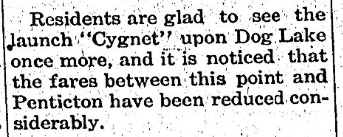
While primarily a cargo ship, the Cygnet had a passenger capacity of sixty, although this number could be exceeded with the addition of a scow. In the spring and summer, the Cygnet was made to ferry passengers for special events, such as celebrations for the King's birthday, Boy Scouts camps, and even moonlight excursions on Skaha Lake. As a passenger in 1912, a round trip on the Cygnet would have set you back $1.00.
One notable trip on the Cygnet came in 1913, when the first trees planted in Kaleden began to bear fruit. The Cygnet was the vessel chosen to deliver the precious first fruit shipment, consisting of 67 apricot crates, from Kaleden to Penticton before it went on to the Scott Fruit Company of Winnipeg.
The Cygnet was moved to Okanagan Lake in the 1920s, where she began an express fruit service delivering cherries from the Stuart Fruit Company and the Mutual Growers of Summerland to Kelowna. This service only lasted a few summer, however, as the Cygnet was put up for sale in the Kelowna Courier newspaper on June 7th, 1928, by a Mr. R. Chaplin.
S.S. Aricia, 1912

Registered no. 134021
Gross Tonnage: 13
Length: 42.7 feet
Beam: 10.1 feet
Another Kelowna-Westbank ferry owned and operated by Leonard Hayman was the S.S. Aricia. The Aricia was a small wooden screw propulsion vessel built by J.T. Campbell in 1912 for service on Okanagan Lake. She weighed 12 tons and featured a passenger cabin, an engine room with a 2hp steam engine, and a pilot house. In case of emergency she came equipped with a life boat and hauled freight, typically cattle and lumber, using a scow.
In 1914, the S.S. Sicamous began passenger services on the lake, convincing Campbell that his ferry would no longer be profitable. The Aricia was sold to Cpt. Hayman for $2,000. Hayman envisioned a ferry line between Kelowna and Westbank, as well as odd freighting jobs that went beyond the sternwheelers typical service route and schedule.
For his first voyage with the Aricia, Hayman was asked to move lumber, as well as hardware and carpenters, for a stable that was to be built on the Westside for government agent, Len Norris. Since people often travelled with their horses, Hayman made the public stable a regular stop, moving cattle, horses, and feed, to and from the site. By 1921, automobiles had become the more favoured mode of transportation. This change necessitated the construction of an extended scow for the Aricia, capable of towing eight cars at a time. Thereafter, she was used as a car and passenger ferry on the lake.
In the Autumn of 1924, Hayman and the S.S. Aricia left Kelowna on a stormy night with six cars on her scow and 19 passengers on board. The boat was pushing against a strong head wind from the west when, opposite the bluff, a sudden gust sent the Aricia off course. At the time, the ship was both pushing a car barge and towing her scow. Cpt. Hayman tried to go full astern but to no avail, the Aricia was headed for the rocks. Quickly, Hayman cut the barge loose in an attempt to save the boat and remembered soon losing sight of the scow thereafter. Large swells were coming over the stern of the vessel while Cpt. Hayman and his engineer both worked to manually free the life boat, as the davit was on the side most exposed to the weather. Hayman recounted, "water was rising in the cabin and the acetyline gas line to the search light was broken. The passenger were being gassed. The engineer fell through the hatch but luckily didn't hurt himself. We got the life boat over the stern." Once all ashore, a call was made to Albert Raymer with orders to bring the S.S. Klatawa, Aricia's auxiliary vessel, to their rescue. Later, Hayman would realize that the scow had hit the shore and rolled to the east before drifting south a whole three miles. The Klatawa retrieved the barge and delivered it's cargo an hour and forty minutes behind schedule. The next day, a dozen men went and freed the Aricia from the rocks and towed her to Okanagan Landing for repairs. The scow was later retrieved and reattached to the Aricia.
The S.S. Aricia continued service for several years after the event. In the late 1930s, the Aricia was sunk by her captain not far from Hayman's Slough.
M.V. Klatawa, N.D.

Originally used as an auxiliary vessel for the S.S. Aricia, the M.V. Klatawa was a small tugboat that performed odd jobs on Okanagan Lake.
Most information available about the Klatawa is written about her involvement in the workings of the S.M. Simpson Sawmill at Manhattan Point, Kelowna. Simpson purchased the tugboat from Leonard Hayman some time between 1931 and 1932. The Klatawa then became the main vessel used at the mill until 1939. Her job was to raise logs that had been rolled into a log boom before hauling them to the mill for processing.
The name "Klatawa" in Chinook Jargon means "to carry," a fitting name for her use as both a ferry and tugboat.
M.V. Skookum II, 1913

Registered no. 134028
Gross Tonnage: 20.7
Length: 50.3 feet
Beam: 10.3 feet
The Skookum II was the second boat named "Skookum" on Okanagan Lake. Skookum II was built by Summerland Boat Works Ltd. for passenger and freight services. She was constructed entirely of wood, save her screw propeller and 2nhp 4-cylinder Scripps gasoline engine.
Just like the Skookum I, Skookum II was owned the Okanagan Lake Boat Company, whose operations had recently been transferred to Peter Roe. A sign of new ownership and vision for the Okanagan Lake Boat Company, the Skookum II was a modern motor launch with a passenger capacity of sixty. She also had scows, constructed to haul heavy cargo to any point on the lake.
In 1913, the Skookum II collided with the S.S. Castlegar, destroying much of the ship. While other records fail to mention the Skookum II after the crash, the Nauticapedia Ship Registry indicates that the vessel was sold to the Canadian National Railway in 1927. From 1938 to 1940, the vessel was supposedly owned by Frederick C. Wilder of Kelowna. Then, from 1940 until 2005, the Skookum II was owned by George H. Flintoff of Kelowna.
S.S. Naramata, 1914

Registered no. 134271,Victoria
Gross Tonnage: 149.94
Net Tonnage: 73.67
Length: 89 feet 8 inches
Beam: 19 feet 5 inches
The second Canadian Pacific Railway tugboat on Okanagan Lake was the S.S. Naramata. The all-steel tug was prefabricated alongside the S.S. Sicamous at the Western Dry Dock and Shipbuilding Company in Port Arthur, Ontario. After testing, the two vessels were disassembled and sent by rail to Okanagan Landing for final assembly. After several months of construction, the Naramata was launched on April 20th, 1914.
The S.S. Naramata used a coal driven Scotch Marine boiler and had a twin cylinder compound steam engine. For maximum efficiency, the engine's cylinders were different sizes, with a 12 and 26 inch bore respectively, and an 18 inch stroke. The boiler had an operating pressure of 1103kPa and a nominal horsepower of 27.3. Her engine room also housed a steam-powered William Sissons generator, a condenser, thrust block, as well as the Duplex fire and manual water pumps.
Mostly moving fruit from packinghouses, efficiency and temperature management were integral to the Naramata's handling of such perishable cargo. The tugboat could travel at speeds up to 19 kilometers per hour and was propelled by a screw. To avoid the heat of the day, the Naramata's crew began service at 2:30 in the morning. The tug would begin in Penticton, stopping for pre-scheduled pickups along the way to Okanagan Landing. The Naramata would typically arrive at the landing around noon before making her return trip to Penticton. Peak harvest season would make for five to seven carloads of fruit for the little tug to carry down the lake. A single carload included 840 orchard boxes, each weighing 40lbs. In the winter, the S.S. Naramata took on the task of breaking channels in the frozen lake for passenger ships, such as the S.S. Sicamous and S.S. Okanagan, to use.
In the early years of her service, the captain was told which wharves to stop at before leaving Penticton or Okanagan Landing. If there were any changes in their schedule, notice would not be received until the Naramata was docked at a community with a CPR agent. In later years, the CPR installed a radio-phone onboard the tug so that the captain could be notified of any changes to their route while sailing.
By 1947, a new diesel-powered tug, called the M.V. Okanagan, took over as the main CPR tugboat. The S.S. Naramata then became a relief vessel, helping during fruit season and for odd jobs. In the summer of 1967, the Naramata assisted for one last harvest season before being permanently docked at Okanagan Landing noon of August 26th, 1967.
The S.S. Naramata then went through several private owners while tied up at the Okanagan Landing Station House. In 1975, the ship was acquired by the Kettle Valley Railway Society and designated an official "heritage vessel." While still under the ownership of the KVR Society, the tugboat was moved to the S.S. Sicamous Marine Heritage Park in 1991. Restoration of the deteriorating tugboat began shortly thereafter. In 1993, the coal storage bunkers in the boiler room had corroded and the Sicamous's cathodic protection system was extended to the Naramata. Finally in 1996 the S.S. Naramata was put under the care of the S.S. Sicamous Restoration Society. In 2020, ownership of the tugboat was transferred to the City of Penticton, with operations remaining under the S.S. Sicamous Society. As of 2026, the S.S. Naramata tugboat is open for guided tours as restoration work progresses into its final stages.

Despite the extensive work done on the tugboat, the S.S. Naramata is currently beached with it's hull under risk of damage. The S.S. Sicamous Marine Heritage Society, Heritage BC, and the City of Penticton are currently working together to raise the S.S. Naramata into a cradle. Rather than using a crane that could potentially damage the tugboat, the groups have decided on a water-lift system to float the Naramata to her new spot. This move is projected to happen in the coming years.
M.V. Mallard II, 1914
Length: 32 feet
The second "Mallard" boat in the Okanagan was a small motor launch with a tunnel stern and a single propeller. The Mallard II was owned by the South Okanagan Transportation Company and operated on Skaha Lake, servicing Penticton, Kaleden, and Okanagan Falls.
According to Harley Hatfield, historian and son of A.S. Hatfield, the Mallard II was the only commercial vessel that was capable of successfully navigating Okanagan River. In August of 1914, the Mallard II had the honour of transporting the first apples ever grown in Kaleden, a whole 129 boxes worth, to Penticton for sale.
In the winter of 1914-1915, the first control dam was built at the outlet of Okanagan River. The dam, intended to regulate water levels, measured 200 feet wide, with a 50 foot opening. For some time, the Mallard II continued her service as usual, climbing over the dam before continuing down the river. That was until one fateful day when the hull of the Mallard II hit the side of the dam, knocking a large hole into the boat. Both the Mallard II and her load of apricots were sent crashing to the bottom of the river. The engines were salvaged and sold, with the rest of the boat left to rot under the water.
S.S. Kelowna, 1920

Registered no. 150271,Vancouver
Gross Tonnage: 95.97
Net Tonnage: 34.69
Length: 89 feet
Beam: 19 feet 4 inches
In the 1920s, the Canadian Pacific Railway began to reduce the CPR Lake and River Service in British Columbia's interior. While four new vessels were added to the fleet, seven ships were simultaneously retired. One of the ships built during this period was the S. S. Kelowna, Okanagan Lake's third CPR tug. The S.S. Kelowna was built by Nickson Construction Company at Okanagan Landing for $35,700 and was of standard CPR tugboat size and design. Unlike the S.S. Naramata but not unsimilar to the earlier S.S. Castlegar, the Kelowna featured a wooden hull. She also had a 150 horsepower engine refit from the Watshan, a CPR tugboat that had operated on Arrow Lakes until 1919. Her boiler carried 160 pounds of steam allowing her to travel at 19 kilometres per hour.
The S.S. Kelowna was built to help the other CPR ships handle the growing traffic on the transfer barge service, specifically handling train cars loaded with fruit and other goods. Side by side with the S.S. Naramata, the Kelowna continued regular barge services through the Great Depression and Second World War before finally being laid up in 1956. She was sold to a private owner in 1957. In June 1959, the S.S. Kelowna was unfortunately beached and broken up at the north end of Okanagan Lake. Today, the steering wheel from the S.S. Kelowna can be found on the cargo deck of the S.S. Sicamous.
Canadian National No. 3 (Radius), 1923

Registered no. 150998, New Westminster
Gross Tonnage: 32.82
Length: 53.5
Beam: 14.6
The Radius was a screw propulsion vessel originally constructed by Dawe Shipyards for the Tug & Wharfage Company of Vancouver, British Columbia. Radius had a steel hull and a 125 bhp engine, manufactured by Atlas-Imperial Engine Company.
From 1923 until 1925, she was captained by John A. Cates doing odd jobs with her scow on the coast of Vancouver, until the stormy day of August 26th, 1925, when the Radius was hit by the Anyox freighter while towing a gravel scow off Prospect Point. The vessel sunk but would later be raised for repair by Beach Avenue Shipyards.

In 1927, the Radius shifted ownership several times. First, she was bought by Ernest Frank Cribb of Vancouver, before switching hands to the Dominion Tug & Barge Company. Then, the Radius was purchased by Canadian National Railways agent, John Y. Rochester, for use on Okanagan Lake. The Radius was sent by train to Kelowna by the Vancouver Drydock and Salvage Company to be refit for barge service. The Radius was then rechristened "Canadian National No. 3." The Kelowna Courier newspaper from June 28th, 1927, reported that several of the tunnels on the CNR line between Vancouver and Kelowna had to be widened to accommodate the still intact CN No. 3.
In 1941, the CN No. 3 was sold to McKean & Wilson Ltd, Vancouver. Canadian National No. 3 had her registry closed on February 2nd, 1953, after her owners reported that the ship had been broken up in Vancouver in July, 1941.
M.V. Pentowna, 1926

Gross Tonnage: 350
Net Tonnage: 300
Length: 127 feet
Beam: 22 feet
Moulded Depth: 9 feet
In 1925, Canadian National Railways had completed a branch line from Kamloops to Kelowna. To accommodate the extended rail service, the CNR built a transfer slip in Kelowna with a new ship, the M.V. Pentowna, for daily operations. The Pentowna was a twin-screw motor vessel prefabricated at Prince Rupert Dry Dock and assembled in Kelowna, after her pieces were sent down by train. Newspaper articles announcing the new ship describe the Pentowna as a "thoroughly modern vessel" for her steel hull and twin diesel engines made her stand apart from common wooden hulled steamers. The decision to launch the first diesel ship on Okanagan Lake was supposedly in the best interest of the fruit, as the heat emitted from steam boilers could very well damage the valuable perishable cargo.
Before her launch, the ship was christened at the Kelowna dock in a ceremony attended by several officers of the CNR, including the companies vice president, general manager, assistant general manager and others. According to the Kelowna Courier Newspaper from May 20th, 1926, Captain Peter Roe had been bestowed the honour of naming the ship. The captain was understandably disappointed when he saw the ship registry in Vancouver and learned that most place names in the BC Interior had already been used and repeated on pre-existing vessels. CNR Vice President, Samuel James Hungerford, is quoted in suggesting a combination of what would be the ships terminus locations, Penticton and Kelowna. All in attendance approved the idea, hence the name "Pentowna."
When she was first put into service, the Pentowna handled passenger, dining, and light freight services. However, due to the completion of the highway in 1935 and services already provided by train, passenger ships were no longer needed. So, in November of 1937, the Pentowna was converted into a tugboat, equipped with a newly fabricated steel barge. The screw was under construction for several weeks, as her upper structure was removed and towing machinery put in.

The Pentowna continued working as a freighter, hauling barges from Kelowna to Penticton, until February 15th, 1972, when the CNR discontinued the last of their tugboats. She was brought down to Peachland on May 2nd, 1974, awaiting a more permanent resting spot. Then, on December 7th, 1976, now owned by John and Richard Dennison of Yellowknife, the Pentowna partially sunk at its mooring. In July, 1994, the now raised Pentowna was purchased by Dennis Dumaresq who towed the ship to Mission boat launch in Kelowna. The ship was then taken by truck to Kelowna's Michaelbrook Ranch Golf Course. Unfortunately, sufficient funds could not be acquired to restore the Pentowna so she was scrapped in December of 2005.
M.V. Kelowna-Westbank, 1927

Registered no. 153323
Gross Tonnage: 104
Length: 94 feet
Beam: 32 feet
The Kelowna-Westbank was a passenger and car ferry that fittingly operated between the communities of Kelowna and Westbank. She was commissioned by the Provincial Government, constructed by Hoffar-Beeching Shipyards Ltd. and captained by Leonard Hayman. The ferry had a 120hp Fairbanks-Morse diesel engine and could carry 15 cars at a time. Because of its size, the ferry also carried two lifeboats and a life raft in case of emergency. The design of the Kelowna-Westbank was a first for the valley, as prior ferry ships more resembled tugboats, hauling cars on barges, than a typical drive-on ferry.

The Kelowna-Westbank ferry service cost $2 per trip and operated six days a week. The ferry left Kelowna at 9am and 3:30pm every day except Sundays, with extra trips offered on Wednesdays and Saturdays at 11am. The ferry would return from Westbank at 9:30 and 4pm, as well as at 11:30am on Wednesday and Saturday. By request, Cpt. Hayman also offered special trips seven days a week. If you booked a trip by request, it would cost you $2.50 between the hours of 7am and 7pm, and $4 thereafter. Commutation tickets were also available for a reduced rate. According to Hayman, by 1937 the Kelowna-Westbank was averaging about twenty-two trips a day. Due to the busyness of the ferry, she was known by some as the "M.V. Holdup"
The success of the Kelowna-Westbank ended up causing her demise as the larger steel "Pendozi" was launched in 1939 to handle the route. After being taken out of service, the Kelowna-Westbank was sent to Okanagan Landing for repairs. There, it was discovered that dry rot had damaged the ferry beyond repair. Her registry closed in 1939.
M.V. Manhattan, 1938

Registered no. 173387, Vancouver
Gross Tonnage: 11
Length: 38 feet
Beam: 10.2 feet
In the late 1930s, the faithful M.V. Klatawa tugboat was finally showing signs of age. S.M. Simpson needed a new boat that could service his ever expanding sawmill, veneer plant, and orchard box factory. So, Simpson commissioned local shipwright, Art Jones, to build a replacement tug. Construction began in 1937 and in September 1939, the wooden keeled M.V. Manhattan was launched. The name "Manhattan" comes from the location of the S.M. Simpson Sawmill, which then comprised most of the land on Manhattan Point, Kelowna.

She had a proper christening ceremony, with the young Rhoda Blanche Simpson officiating and Jack Cooper, Mike Paley, Jack Riley, and Art Jones in attendance. Note that some articles claim that the Klatawa and Manhattan were the same ship, built in 1929 and only registered in 1940. There is no evidence to prove this assertion as several photos exist of the two tugs side by side.
The M.V. Manhattan operated between Peachland and Whiteman's Creek, near Vernon, freighting log booms to the sawmill in Kelowna. In 1948, the original 1.50hp 4-cylinder gasoline engine was replaced with a 65hp 6-cylinder diesel engine. This repower offered greater efficiency and a reduced cost of operation, overall extending the life span of the tug.
The Manhattan was retired from mill operations in 1967 as the then newer M.V. Stanley M. tugboat was better equipped for the company's changing needs. She was tied up in the bay between Sutherland Park and Manhattan Point until Bill Hewlett purchased the tug. Not long after, Hewlett sold the Manhattan to Ron Smith, who had the tugboat moved to his yard. In 1989, Smith no longer wished to bear the Manhattan's steep restoration costs and sold the ship to Bill Kennedy. Under Kennedy's care, the Manhattan had its decking stripped off, cabin extended, and had a diving transom installed. The transom extended the length of the ship from 38 feet to 42 feet. On top of the changes made to the exterior, the engine underwent repair and the interior was completely refurbished. Construction was complete three years later in 1992.
The new Manhattan was hauled onto a low-bed truck and launched at Gellately Bay. In 1995, Bill Kennedy sold 50% of the Manhattan's shares to his brother and sister-in-law, Don and Sheila Kennedy. Together the Kennedy family continued to enjoy the converted tugboat as a recreational vessel on Okanagan Lake. In 2006, the 58 year old Caterpillar engine was finally laid to rest. In its place came a 4-cylinder 120hp Chrysler Mitsubishi diesel engine. In order to do such an extensive repower, the floor over the roof and engine compartment had to be temporarily removed.
The Manhattan continued to run through the 2000s and 2010s, with marine inspections every five years to ensure that the seventy year old boat stayed up to code. The last mention of the boat is 2011, leaving her current fate unknown.
M.V. Pendozi, 1939

Registry no. 171619
Gross Tonnage: 238
Length: 122.4 feet
Beam: 41.4 feet
Built by Hamilton Bridge Western Ltd. for the British Columbia Toll Bridge Authority, the M.V. Pendozi was the first steel passenger and car ferry that operated between Kelowna and Westbank. She had a 320hp 16-cylinder oil engine, built by Vivian Engine Works of Vancouver. The name "Pendozi" comes from the first settler in Kelowna, Father Pandosy the Oblate priest. Curiously, both the ferry and street named in honour of the priest are spelt incorrectly.
In 1947, the Pendozi ferry was sold to the Minister of Public Works, before going to the Minister of Highways for the Province of British Columbia.
On July 19th, 1958, the Okanagan Lake Bridge between Kelowna and Westbank was opened in a ceremony attended by Princess Margaret. The pontoon style bridge was the first floating bridge in the country and eliminated the need of a ferry service between the two communities. Despite the impact that it made on the Kelowna-Westbank ferry service, the bridge was specifically designed with ships in mind, featuring a lift span for marine traffic, therefore impacting certain ferries but not the other work boats on the lake.
The M.V. Pendozi was sold to the City of Kelowna for one dollar and had become something of a mooring issue for the city since then. On January 1st, 1965, the M.V. Pendozi sank at the Canadian National Railways wharf in Kelowna. By that point, the retired ferry had already had her engines removed but her cooling discharge ports were mistakenly left open, allowing water to seep in. West Kelowna resident and Westbank Yacht Club commodore, Alan McLeod, had the idea that the ferry would make a fine clubhouse. While the ferry remained sunk, club members McLeod and Clare Small made an offer of two dollars for the Pendozi. The proposal was taken to city council by Mayor Parkinson and on February 8th, 1965, the M.V. Pendozi was donated to the Westbank Yacht Club.
The club decided to beach the old car ferry at the north end of the breakwater, not far from Gellately Bay. Lorne Dobbin hauled a rented drag line to the site and a channel was dredged to bring the ship onto shore. Then, on March 1st, came the Pendozi, towed by the M.V. Manhattan, to her final resting spot. As the Manhattan pulled the Pendozi forward, the captain realized that the channel had not been dredged deep enough and the ferry was stuck on a gravel bar two hundred feet out. The next day, the local Canadian Pacific Railway branch was notified of the situation and was asked to bring one of their tugboats to the rescue. The CPR tug, most likely the M.V. Okanagan, freed the Pendozi and got her onto the beach.

Designs for renovations were made up by naval architect Bill Reid, McLeod's brother-in-law. The hull was restored by Syd Saunders and Bert Longely. Jack Maddox built new railings and converted the boiler room plates into tables. Wiring was done by Charlie Hoskins and plumbing by Clare Small. According to the yacht club, the finished clubhouse included, "a large lounge, paneled in mahogany and knotty pine, a similarly decorated boardroom, a roomy open-air dance floor (with a roof), a kitchen complete with fridge, stoves and plenty of counters and cupboards; refreshment bar, washroom facilities and lockers. This was all topped with a sundeck large enough to accommodate 250 people." As of 2026, the clubhouse remains inside the Pendozi ferry and is open to members of the West Kelowna Yacht Club.
Canadian National No. 5, 1930

Registered no. 156887
Gross Tonnage: 68
Length: 67.3 feet
Beam: 17.3
One of the more obscure Canadian National tugboats on our lake, the Canadian National No. 5 was built by the Prince Rupert Dry Dock & Shipyards Company before being assembled in Kelowna. She originally had a 30hp engine but was later repowered with a Norris Hentry & Garddner 300nhp diesel engine.
The tugboat was launched on March 8th, 1930, in front of a large crowd of spectators. One man in attendance was "Jock" McGill, an employee of the Prince Rupert Dry Dock Company. McGill was sitting on the gunwale at the stern of the tug and was submerged under water upon the ships launch. Several people jumped in to save the man but to no avail. Jock McGill was finally recovered from the water 45 minutes later and was pronounced deceased at the scene by Dr. A. S. Underhill of Kelowna.
After 35 years on Okanagan Lake the CN No. 5 was retired from service. CN No. 5 was then moved to Vancouver, where she was rebuilt into a dragger fishboat in 1965. On February 11th, 1990, CN No. 5 was caught up in a snow storm in the Georgia Strait. The tugboat and all four members of her crew were lost.
M.V. Okanagan, 1947

Registered no. 5261491
Gross Tonnage: 204
Length: 110 feet
Beam: 23 feet
After 1930, only three new vessels were added to the Canadian Pacific Railway Lake and River service. The second was an all-steel diesel-powered tugboat called the M.V. Okanagan. The M.V. Okanagan was built by the Westcoast Shipbuilders of Vancouver and assembled at Okanagan Landing for approximately $200,000.
Launched on February 18th, 1947, the M.V. Okanagan was a true product of her time, being the first CPR diesel ship to operate on Okanagan Lake. Unlike most other vessels on Okanagan Lake, the Okanagan had her pieces brought down for assembly by truck, rather than train. M.V. Okanagan was also fit with a 800hp Washington-Estep diesel engine (no. 7602), which enabled her to push two barges, each weighing about 700 tons, at an average speed of 11 miles per hour (17.70 km/h). The tug cost approximately $200,000 to be built.
On August 27th, 1951, the M.V. Okanagan had the honour of aiding the S.S. Sicamous on her final voyage down Okanagan Lake. The Sicamous was pushed with a barge from Okanagan Landing to Penticton, and maneuvered by the M.V. Okanagan into the spot where she now resides.
By the 1960s, the Okanagan was the CPR's regular year-round freight boat, with the S.S. Naramata as her relief vessel. While she could very well handle two 10-car barges at a time, the Okanagan was typically seen moving only one barge. The M.V. Okanagan remained in service until May 31st, 1972, when the Canadian Pacific Railway suspended barge services in the valley.
M.V. Lequime (Fintry Queen), 1947

Registered no. 177983
Gross Tonnage: 581
Length: 122.7 feet
Beam: 41.4 feet
The second of three government car ferries between Kelowna and Westbank, the M.V. Lequime was owned and operated by the B.C. Department of Highways between 1947 and 1961. The name "Lequime" comes from a local pioneer family in Kelowna. Eli Lequime was the town's first postmaster, while his sons, Bernard, Gaston and Leon, operated a blacksmith shop, trading post, and the Kelowna Sawmill for a time. Marie-Louise Lequime, Eli's wife, was the first doctor of L'Anse au Sable, now Kelowna, and the Pandosy Mission.

After the installation of the Okanagan Lake Bridge in 1958, the M.V. Lequime's service became redundant. The ferry was retired and renovated into a passenger cruise ship, with a design inspired by American paddle wheelers. On August 31st, 1968, the M.V. Lequime was re-christened the M.V. Fintry by Pasquale "Cap" Capozzi. Rather than carrying cars, M.V. Fintry, also known as the Fintry Queen, now operated as a restaurant for dinner cruises on Okanagan Lake. This service lasted several decades.
In 2024, the Fintry Queen was sold to the Okanagan Luxury Boat Club for $550,000. The new owners hope to have the boat restored and running as a dinner cruise ship in the future.
Canadian National No. 6, 1948

Registered no. 190311
Gross Tonnage: 157.7
Length: 89 feet 6 inches
Beam: 22 feet
Depth: 10 feet 6 inches
The Canadian National No. 6 is a diesel-powered screw propulsion tugboat that was operated by the Canadian National Railways on Okanagan Lake between 1948 and 1973. CN No. 6 was built by Yarrows Limited of Esquimalt, BC, for CNR barge services between Penticton and Kelowna. After her initial construction at the Yarrows dry dock, the tug was knocked down and sent by rail to Okanagan landing for final assembly. The tug is constructed entirely of steel, weighing 159 tons. The tugboat has a supercharged six-cylinder enterprise engine, developing 575 brake horsepower. She is also equipped with a 110-volt DC diesel generator and the towing winch, windlass, and steering gear were all hydraulically driven. Upon completion, CN No. 6 was registered in Vancouver, No. 190311 and launched August 6th, 1948. Alongside CN No. 6 also came a new barge, built by the West Coast Shipbuilders in Vancouver. The barge was designed to carry ten rail cars, spanning 240 feet in length with a 39 foot beam.
Daily operations began southbound from Kelowna at 8am Tuesday to Friday, after having been loaded up with Extra South freight cars by a GE 44ton class ER-4b 4 switcher. CN No. 6 would stop as required along the way to Penticton, typically arriving by noon, before receiving northbound traffic and returning back to Kelowna around 5pm. On Mondays, CN No. 6 left Kelowna at 4am with refrigerated carloads of meat. The earlier trip gave the tug enough time to supply grocery stores with fresh meat before the beginning of each week. Once every three weeks, a box car full of liquor from the BC Liquor Control Board would also be taken down the lake by CN No. 6. On one particular trip, the alcohol bottles had been smashed while the train car was being shunted. Upon opening the door, all the alcohol spilled out onto the deck. Deckhand, Ed Slater, recalled that the train car was simply sealed up and sent back to Vancouver as rejected cargo. In her last years, CN No. 6 made one scheduled run per day, Monday to Friday, beginning in Kelowna and stopping in West Kelowna, Summerland, and Naramata before reaching Penticton. Her cargo was largely dependent on the season, with her barge freighting everything from fruit and lumber to gasoline and ore.
Despite regular scheduled operations, the CN No. 6's traffic volume began to rapidly decline after the closing of the Crown-Zellerbach lumber mill in Peachland in 1971. Additionally, refrigerated trucks and other highway vehicles proved to be more efficient than their marine counterparts, contributing to the dwindling demand for barge services in the Okanagan Valley.
After her retirement on February 15th, 1973, CN No. 6 was tied up at Fintry landing and put up for
sale to the public. Rumour spread of a Mr. Robert Coyne of Wetaskiwin, Alberta, having purchased the tug and several barges for use on the Churchill and Mackenzie rivers. However, on Okanagan Lake she remained. Thereafter, the tug went through several owners. She was quickly resold to Arthur Bailey of Fintry, B.C in 1973. Then, in 1993, the Kelowna Museum and Archives purchased tug No. 6 for $35000 from an Angela Percy with the intention of turning her into a floating museum. Another idea was to have the tug as an Ogopogo spotting station, including displays of the lake monster throughout. These plans were never realized and the CN No. 6 was sold to the S.S. Sicamous Marine Heritage Society in 2004. On June 16th, 2007, the CN No. 6 was moved to the heritage park where she remains afloat today under restoration.
M.V. Stanley M., 1948

Registered no. 179622
Gross Tonnage: 9.96
Length: 29.1 feet
Beam: 10.5 feet
Named after it's owner, Stanley Merriam Simpson, the M.V. Stanley M. tugboat was used by the S.M. Simpson Sawmill in Kelowna. The all-steel tugboat was built by John Manley Ltd. in New Westminster, B.C. The ship was sent in two pieces on the Kettle Valley Railway, before being assembled and launched in Kelowna. Designed to transport heavy logs and other cargo to the sawmill at Manhattan Point, the Stanley M. had a 65hp engine and was propelled by a screw.
In 1961, after several fine years of service, the tugboat was repowered with a 137hp diesel engine. Her captain Arthur Marty, who also captained the M.V. Manhattan, and her skipper was Shige Kawahara.
The M.V. Stanley M. witnessed many changes to the forestry industry in Kelowna. She was first under the ownership of S.M. Simpson Ltd. and watched as the company was bought out by Crown Zellerbach, then Riverside Forest Products, before finally working under Tolko Industries in 2004. The Stanley M. continued operating until the 2010s. Her registry was closed on March 7th, 2012, and the tug was laid up at Tolko Industries in front of the original 1930s S.M. Simpson factory building. In 2020, Tolko Industries was permanently closed and the original sawmill building was demolished in 2025. The whereabouts of the tugboat have not been confirmed.
M.V. Lloyd-Jones, 1950

Registered no. 192296
Gross Tonnage: 277
Length: 136.7 feet
Beam: 36 feet
The last passenger and car ferry to operate between Kelowna and Westbank was the M.V. Lloyd-Jones. The Lloyd-Jones was designed by Robert Allan Ltd. and built by the Victoria Machinery Depot Company for the British Columbia Minister of Highways. Just as the two government car ferries before her, the M.V. Lloyd-Jones operated between West Kelowna and Kelowna until 1958, when the Okanagan Lake Bridge opened. In their final year of service, the Pendozi, Lequime, and Lloyd-Jones together transported 534,373 cars across the lake. The Lloyd-Jones could carry 35 cars and took 10 minutes to get from Kelowna to West Kelowna.
The Lloyd-Jones was named after Kelowna businessman David Lloyd-Jones who served on Kelowna's first city council and helped establish the Kelowna Hospital. Mr. Lloyd-Jones also built and operated the first Kelowna Sawmill, later to be owned by the Lequime Brothers and S.M. Simpson.
Still a perfectly fine vessel, the Lloyd-Jones was purchased by BC Ferries in 1962, before being disassembled and transferred to the coast. There, the ferry became known as the Bowen Queen, ferrying route 8 from Horseshoe Bay to Snug Cove. In 1965, the ferry was replaced by a larger ship, also named "Bowen Queen." The ferry was then transferred to route 6 between Crofton and Vesuvius Bay and re-christened, "Vesuvius Queen." The Vesuvius Queen continued on route 6 until 1992, when the Howe Sound Queen was launched. The ferry remained on the coast as a relief vessel until 1998 when it was sold to R & G Importadora & Exportadora of the Dominican Republic.

Several factors contributed to the demise of Okanagan ferry and barge services. Foremost was the adoption of more modern modes of transportation, such as automobiles, public buses, and semi-trucks, that rendered both passenger and cargo services obsolete. The opening of the Okanagan Lake Bridge in 1958 further accelerated this transition by prioritizing road traffic over the ships. At the same time, the industrial infrastructure required to support commercial shipping, including wharves, mooring hardware, and barge slips, occupied some of the most valuable waterfront property in the valley. As Okanagan communities expanded, so did the demand for this land. With ferry and tugboat operations no longer considered essential, there was greater economic incentive to redevelop the waterfront than preserve its working harbors. Following the retirement of the CPR tugboats in 1972 and those of the CNR in 1973, work began almost immediately to demolish many of the remaining wharves as part of urban renewal projects.
The disappearance of these workboats is no indication of the role they once played in the development of the valley. Long before modern highways connected the Okanagan, tugboats hauled the fruit trees, rail ties, and building materials that established our communities. Sawmill tugs moved the lumber used to build homes, businesses, and orchard boxes that carried local fruit to market. Simultaneously, the CPR and CNR tugboats carried produce to markets both within and beyond the valley while also delivering gasoline, rail cars, and other essential supplies. Government and privately operated ferries likewise connected communities separated by the lake, transporting passengers, livestock, vehicles and freight.
Although they have never enjoyed the same recognition as the famous sternwheelers, these hardworking vessels were every bit as important to the valley's history. Much of Okanagan Lake's working history disappeared with the wharves and train tracks, but their legacy remains all around us.
*Beyond this list, some other lesser-known work boats included the Peewit dredging tug, as well as the Rattlesnake, Maude Allen, Quimby, Gwendolyn, Grace Darling and the Orchard City I and II tugboats.
Bibliography
Dag, Pluton. “Chapter Four: And We Thought We Would Be Spared, 1930–1940 -- KnowBC - the Leading Source of BC Information,” https://www.knowbc.com/limited/Books/The-Kelowna-Story/Chapter-Four-And-We-Thought-We-Would-Be-Spared-1930-1940.
“Fifth Annual Report of the Okanagan Historical and Natural History Society,” https://open.library.ubc.ca/viewer/ohs/1.0132184#p7z-3r0f:The%20Steamer%20Penticton.
“Forty-eighth Annual Report of the Okanagan Historical Society,” https://open.library.ubc.ca/viewer/ohs/1.0132213#p46z-4r0f:pentowna.
Goett, R. Bruce, British Columbia Heritage Trust, Lake Country Heritage and Cultural Society, Kelowna Museum, Vernon Museum, and Wayne Wilson. “Lakeboats of the Okanagan,” 2011. https://lakecountrymuseum.com/wp-content/uploads/2024/05/Lakeboats-of-the-Okanagan.pdf.
Hayman, Leonard A., and Bob Hayman. Captain Len’s Ferry Tales of the Okanagan. Wood Lake Books, 1988.
Hutchings, Shawn. “Transportation on Okanagan Lake,” 2000. https://static1.squarespace.com/static/5995f4e96b8f5b9ef7c7355f/t/5d1bbfbec1cffe0001f66f7e/1562099720448/6-Okanagan+Lake+Transportation.pdf.
“Okanagan History. Fifty-ninth Report of the Okanagan Historical Society,” https://open.library.ubc.ca/viewer/ohs/1.0132233#p117z-3r0f:aricia.
“Okanagan History. Fifty-sixth Report of the Okanagan Historical Society,” https://open.library.ubc.ca/viewer/ohs/1.0132229#p22z-5r0f:collen%20rowboat.
“Okanagan History. Sixty-seventh Report of the Okanagan Historical Society,” https://open.library.ubc.ca/viewer/ohs/1.0132244#p46z-4r0f:pentowna.
“Okanagan History. Sixty-third Report of the Okanagan Historical Society,” https://open.library.ubc.ca/viewer/ohs/1.0132238#p124z-3r0f:aricia.
Symonds, B.J., P. Eng. and Ministry of Environment, Lands and Parks. “Background and History of Water Management of Okanagan Lake and River,” 1929. https://a100.gov.bc.ca/pub/acat/documents/r51370/OkanaganRiverandfalls_1477428399414_7410727291.pdf.
“The Nineteenth Report of the Okanagan Historical Society 1955,” https://open.library.ubc.ca/viewer/ohs/1.0132194#p132z-4r0f:tugboat.
BCRDH. “Third Annual Report of the Okanagan Historical and Natural History Society,” 1929. https://bcrdh.ca/islandora/object/ohs%3A83?solr_nav%5Bid%5D=61c99d4b0989ef3484c0&solr_nav%5Bpage%5D=3&solr_nav%5Boffset%5D=19#page/24/mode/2up.
“Thirty-third Annual Report of the Okanagan Historical Society,” https://open.library.ubc.ca/viewer/ohs/1.0132204#p29z-4r0f:tugboat.
Penticton Herald. “Tolko demolition another loss for Kelowna’s local history,” February 16, 2023. https://www.pentictonherald.ca/news/article_c7a98afe-ada9-11ed-b0d6-6b4ab4bcd66b.html.
Turner, Robert D. Sternwheelers and Steam Tugs. 2nd ed. Sono Nis Press, 1998.


Comments